 |
|
|
|
Formative Occupations - Before
the Tiwanaku diaspora
|
Recent systematic survey in Peru's Moquegua Valley, has defined a distinctive regional tradition known as Huaracane that flourished before the Tiwanaku colonization (presently dated from 385 cal B.C - cal A.D. 340). The Huaracane were characterized by a dispersed settlement pattern in the floodplain, a distinctive ceramic tradition and complex mortuary practices. Results of the Moquegua Archaeological Survey establish a baseline for the population size and settlement patterns of the Formative / Huaracane Phase. and no evidence of Tiwanaku occupation of pre-existing Huaracane sites was found. Huaracane's settlement pattern was distinguished by a continuous belt of small valley-side agricultural settlements. This differed considerably from the Tiwanaku tendency to live in far larger colonies, some distance from the floodplain.
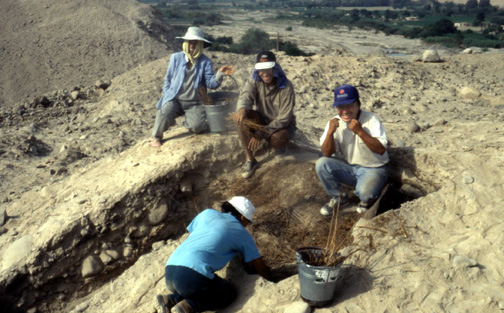
In 1998-99, we were able to examine four Huaracane sites out of the numerous small agrarian settlements and cemeteries we recorded in the Moquegua Valley. Surface collections and test excavations at Huaracane sites confirm a minimal presence of exotic Pukara and Paracas-Nasca ceramics and textiles in association with elite Huaracane contexts. Huaracane mortuary tradition includeed "tumulo" mound burials and "boot tombs" that appear after 170 cal B.C. Our surface collection and excavation results so far confirm that Huaracane differed in subsistence, settlement and mortuary patterns from the later highland Tiwanaku occupants of the valley. There was no evidence that Tiwanaku settlers occupied the pre-existing Huaracane sites, nor that Huaracane inhabitants adopted Tiwanaku culture. Research planned for 2003 will focus on examining and dating additional late Huaracane settlements and considering their possible interaction with the initial Tiwanaku colonists.




Copyright ©2003 Paul S. Goldstein. All rights reserved.
