What is access?
The idea of access is very broad and general today. The term has evolved with its meaning. Initially, access referred to having computers, it grew to mean more than just the boxes. Access meant being connected to the World Wide Web. In 1999, its meaning is multifaceted. Do you have the boxes, are you connected to the Information System and in what ways are you and your students given access to the capabilities of both the boxes and the networking?
To answer these questions we must look at where we are and where we want to go as we approach a new decade. In 1994 the growth of the World Wide Web was growing at exponential growth. In 1995 over 29 million hosts were connected to the Internet worldwide (Network Wizards, 1998), and in 1998 somewhere between 60 to 75 million adults in the United States have access (Cyber Atlas, 1998). The Internet has undoubtedly become the most important communication innovation in history.
President Clinton's aggressive objective to wire every classroom and library in the country by the year 2000 (Clinton, 1997), followed by every home by the year 2007, is expected to do no less than virtually transform society. Yet as the Internet moves toward critical mass, some scientist are beginning to examine the demographic patterns of Internet access and usage. While millions are using the Internet today, findings thus far are laying important implications for social science research.
Internet Service Providers
Information infrastructures are in different stages in different countries and there exists a wide variety of networks and applications, examples: wireline and wireless telephony, information services based on toll-free numbers, cable TV, Internet, on-line services, and more. Each country has some degree of these capabilities, however, the United States and Canada are still further ahead in Internet Service Providers (ISP).
Economic and social access and its current problems include a combination of lower economic classes needing the tools to keep up with others who have already connected, and the legislatures unable to find sources to fund these classes' needs. The US is taking steps to try and rectify these problems.Figures for January, 1994 Source: Internet Society
Country # of Internet Service Providers North America Western Europe Pacific Rim Asia Other: Eastern Europe
The United States pledged itself to a five-year program to boost access to the Internet dramatically in 20 African countries. Vice-President Al Gore told a Group of Seven-sponsored Information Society and Development (ISAD) conference in Johannesburg, Africa, that the worldwide network of personal computers was a potential gold mine of information for remote communities. "Access to the Internet can be a powerful tool for Africa's economic and social development," Gore told delegates of ISAD via a satellite link-up. (Electronic Library, 1996)
The conference considered steps to muster information technology in developing countries to make sure they do not fall behind. South Africa could played an important bridge between the industrialized and developing world. Additional conferences were held in Brussels, in which the United States, Canada, Japan, Britain, France, Germany and Italy urged the promotion of a information society.
Social and Economic Access to the Internet
Variables such as income and education are key to the different impact the consequences of interactive electronic media will have for the different segments of our society. The largest concern is that the Internet will create what Lloyd Morrisett, the former president of the Markle Foundation, has called a "digital divide" between the information "haves" and "have-nots." For example, almost 70 percent of schools in the United States have at least one computer connected to the Internet, but less than 15 percent have Internet access (Harmon 1997). Access is correlated strongly with income and education. While the gender gap seems to be closing over time, the gap for race is not decreasing (Abrams 1997).
The gap between the "techno-haves" and the "techno-have-nots" is far reaching to the development of our next generation. Research done in 1996 by CommerceNet/Nielsen Internet Demographic Society (IDS) found that while not surprisingly, that African Americans and Whites differ significantly in computer access and web use. The research reported that whites were more likely than African-Americans to have a home computer 44.2% to 29..0%. While at work whites were also more likely to have access to a personal computer, 38.5% to 33.8%, although this is not as significant.
The research went on to discover that whites were more likely to currently have computer access, whereas African-Americans were more likely to state they would like to acquire access. Nearly twice as many African-Americans that whites responded they plan to buy home computers in the next six months. When questioned about Internet access, whites again were more likely to have ever used Internet, 26% to 22%. The gap between the two was even larger the more recently the respondent had last used the Internet. Whites and African-Americans differ also in location of use of Internet. Whites were more likely 14.7% to 9% to have used Internet at home. African-Americans were more likely to have used Internet at school.
When IDS further evaluated computer
access as associated with income. In household incomes earning lower than
$40,000, whites were more likely than African Americans to own a home computer.
For household incomes of $40,000, or more, a larger percentage of African
Americans own a home computer. Although the difference was not significant
in the over $40,000, it was determined that the increasing levels of income
corresponded to the increased likelihood of owning a home computer, regardless
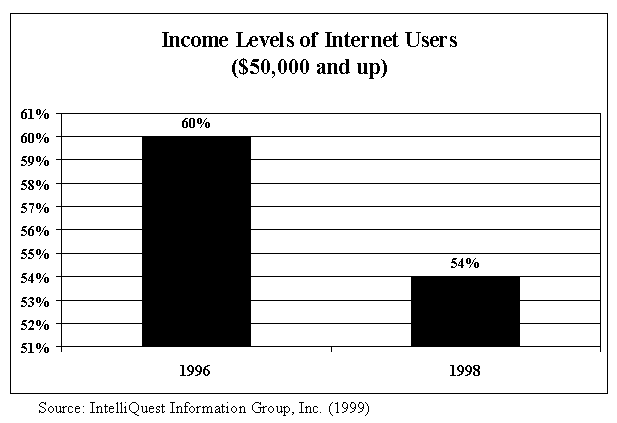
of race. Another study recently done by IntelliQuest Information Group found
that in early 1996, households earning $50,000 per year had Internet access.
That number dropped in 1998.
Regardless of ethnicity or income, students are overwhelmingly the highest users of the Web regardless of where they connect (home, school, library, friends' homes). White students are still more likely than African Americans to use the Internet. Given a home computer, this race difference goes away. This suggest the importance of creating more access points for all in libraries, community centers, and nontraditional places for individuals to access the Internet. But the need goes further. Having the points is not enough. Encouraging usage is equally important.
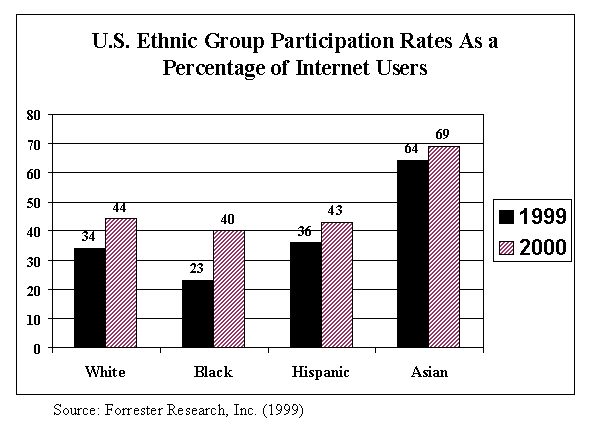
In recent data collected by Forrester
Research found that Internet access for African Americans is 23% today, and
that it will reach 40% by the year 2000. This research also collected data
on other ethnics: "Access for Hispanics is today at 36%, and it will reach
43% by 2000. Americans of Asian heritage are most likely to be Internet users.
The Forrester study found 64% of Asian Americans are on the Internet today,
and projects that by 2000, 68% will be."
Income is not the only issue connected
to the issue of access to the Internet. Research reveals education also comes
into play as to whether or not a home is connected. The IDS data found that
while income is a factor, education is what counts. Increasing levels of
education influence both owning a computer and having Internet access. A
1999 study conducted by IntelliQuest Information Group estimated that 46
percent of U.S. Internet users in 1996 had attained the educational level
of at least a bachelor's degree.
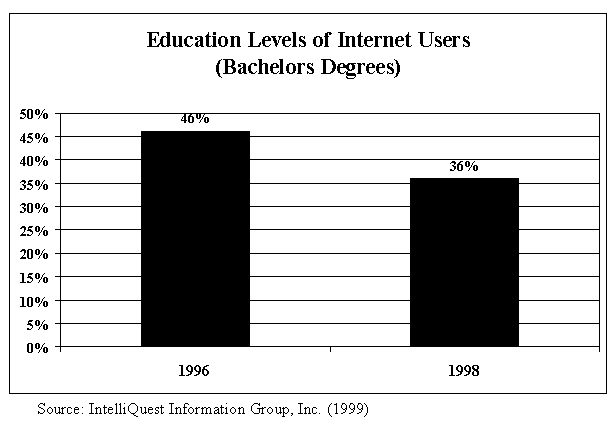
By 1998, the percentage of users
with a bachelor's degree had dropped to 36 percent of all users.
A Future for Minority Access
For low-income minorities, the cost of Web access ($13 - $20 a month) can be a finical burden, not to mention the up-front expense of purchasing a computer system. A 1996 Yankelowich study found only 22% of U.S. blacks have home computers vs. 34% of all Americans. Many groups have committed themselves to providing access to low-income families. Plugged-In is a nonprofit organization that provides free computer and Internet Access in low-income East Palo Alto, California. LBJ Policy Research Project , another group which provides access to low income families in East Austin, Texas is committed to giving Internet access to low-income citizens.
The biggest issue keeping blacks
off of the Web may be the perception of African Americans not seeing the
value of the Internet. Many technologies are coming down in price and may
be more affordable to the low-income classes. As prices continue to more
affordable, "the Internet will become more prevalent in the African-American
community," says Larry Irving, 1996, assistant secretary of Commerce and
head of the Commerce Department's National Telecommunications and Informations
Administration. Large companies including Microsoft see the possibilities,
launching Web sites to pull the Black Community to the Internet. (Source:
Electronic Library)
Benefits of the Information Society
Some of the major societal and economic benefits of a Global Information Society that each country and the region as a whole can achieve for its people are listed below:
2.) Getting America's Students Ready for the 21st Century: Meeting the Technology Literacy Challenge , Richard Riley, Secretary of Education
3.) National Center for Educational Statistics
1.) Abrams, Alan
Diversity and the Internet, Journal of Commerce, June 19962.) Carter, Kim
Stretching Your Technology Resources, Technology and Learning, March 19993.) President Bush
Accessibility (February, 1997)4.) CommerceNet/Nielsen Internet Demographic Society, 1997
5.) Cyber Atlas, 1998
6.) Electronic Library, 1996
7.) Erate Primer , 1999
8.) Forrester Research, 1999
9.) IntelliQuest Information Group, Austin, Texas: Microsoft Intelliquest,1999
10.) Internet Society, 1994
11.) Network Wizards, 1998
12.) Neuman, Delia, Technology and Equity, Dec. 1991
13.) Novak, Thomas & Hoffman, Donna
Bridging the Digital Divide: The Impact of Race on Computer Access and Internet Use (February, 1998)14.) Riley, Richard
Getting America's Students Ready for the 21st Century: Meeting the Technology Literacy Challenge (June 1996)15.) State of the Internet USIC's report on the state of the Internet on use and threats in 1999
Credibility & Web Evaluation
/ Free Speech, Censorship
/
Privacy
/ Commercialization
/ Intellectual Property, Plagiarism
/Computer Crime