An Educator's Guide to Accessibility Issues
home / gender bias / accessibility / funding / hearing disability / visual disability / other disabilities
Introduction
While the issue of access involves more than simply obtaining a computer with an Internet connection, this section will outline the progress made in obtaining Internet access for all. Presently, most access statistics being collected pertain to any form of Internet connection. However, with the rapidly changing format of technology and the Internet, the present push is toward obtaining high speed access for all.
Issues
Home Usage
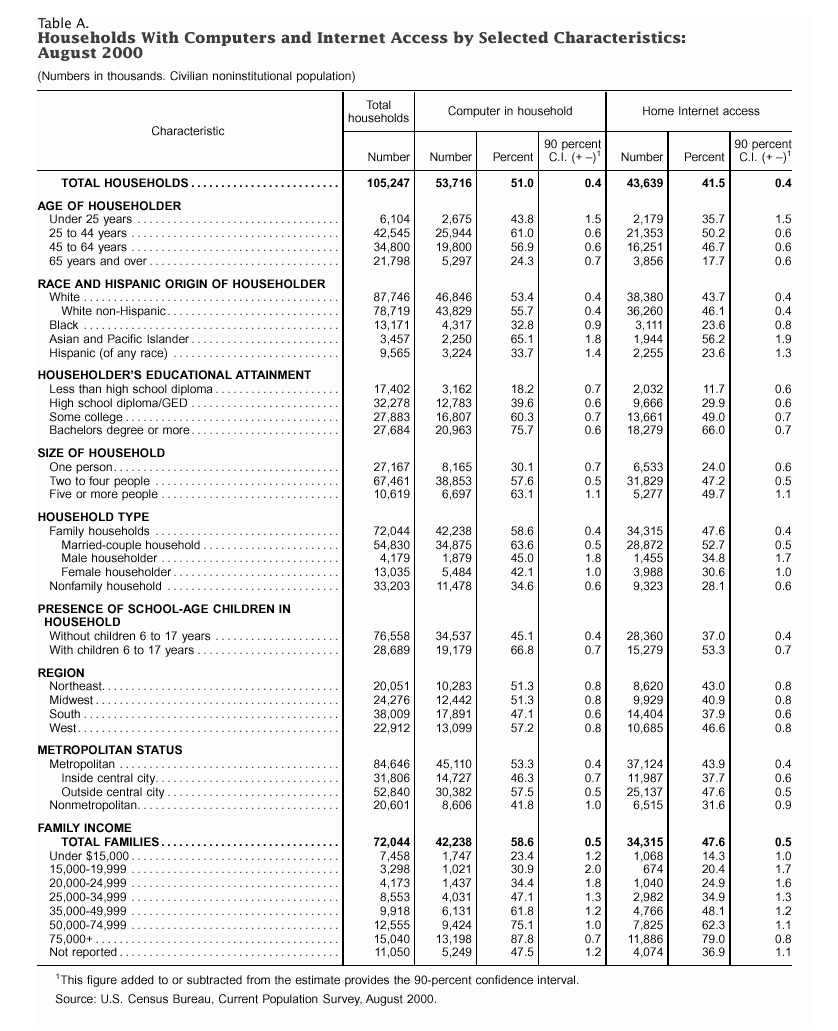
As the price of computers continues to fall, more and more consumers are purchasing computers for their homes. According to the August 2000 census figures, 51% of households owned at least one computer. At the same time, 42% of households had Internet access on at least one computer (U.S. 2001). This is a dramatic increase from 1997 (the first year the statistic was recorded) when only 18% of U.S. households had Internet access. The number of home computers with Internet access continues to grow each year. (See Table A)
Income
Income continues to be a huge dividing factor for technology access. However, the statistics are slowly improving. As of August 2000, in households with an income of $75,000 and higher, 87.8% of them owned at least one computer and 79% had home Internet access (U.S. 2001). In stark contrast, in households with an income of $15,000 or less, only 23.4% owned a computer and 14.3% had Internet access. Yes, the price of technology is decreasing thereby increasing the prevalence of technology. However, for those struggling simply to keep a roof over their heads, computers and Internet access are luxuries they cannot afford. (See Table A)
Education
The level of education attained by an individual is also a determining factor in technology access. Not only does the level of education generally influence one's income, but for many people higher education creates a greater interest in and perceived use for technology in the home. In August 2000, 75.7% of U.S. households with at least one member achieving a college education owned a computer (U.S. 2001). Sixty-six percent had Internet access. Of high school graduate households, only 39.6 % owned computers with 29.9% having Internet access. (See Table A)
Geography
Where a person lives also affects his or her access to technology. Not only do suburban residents have more access than urban or rural residents, but certain regions of the U.S. have more access than others (U.S. 2001). The West has the greatest number of homes with computers and Internet access while the South has the least. Many interpretations may be made about this data, but the western states do have the advantage of being home to many of the nation's leading technology firms. (See Table A)
Race
Race continues to be a dividing line for technology "haves" and "have-nots." According to August 2000 census figures, blacks are the least likely of any racial group to have a household computer or Internet access. Unfortunately, the numbers at both ends of the spectrum are not even close. Fifty-three percent of white households had access versus 32.8% of black households (U.S. 2001). Latinos also fall behind significantly in technology access. (See Table A)
Children
Fortunately, the statistics change for children. While serious income, education, and racial gaps exist, schools have helped to equalize access across racial and income lines. However, it's important to remember that reports, such as the one created by the U.S. Census Bureau, simply give us statistics of access. These statistics do not mean that technology is being used to the same effect for all students.
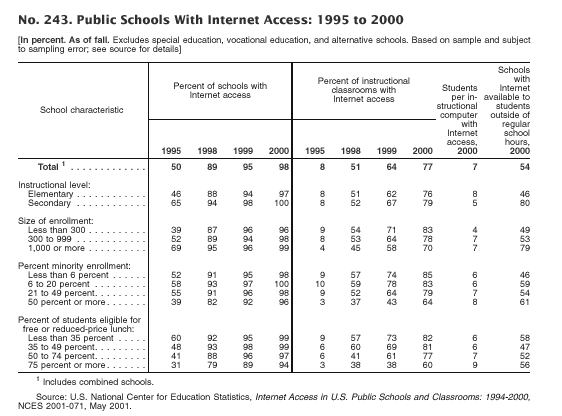
Yet, technology access is the first step and the vast majority of U.S. children have it. As of August 2000, only 10.4% of children had no access. Without the opportunity for school technology access, that figure would increase to 33.2% of children with no access (U.S. 2001). Therefore, school technology access, in addition to library and community center access, is vastly closing the gap for all school-age children in the U.S. Schools are equalizing access across income and racial lines (See Chart No. 243). That is why continued funding of technology programs is vitally important.
Source: Home Computers and Internet Use in the United States, August 2000
Content
In March 2000, the Markle Foundation and The Children's Partnership released a report entitled "Online Content for Low-Income and Underserved Americans: An Issue Brief." In this report, the organizations stressed the need for improved accessibility to useful information for low-income individuals. According to their study, Internet content is not useful for 20% of the U.S. population. Two main reasons exist: non-English speaking people cannot read most Internet sites for understanding or people cannot find the information they need, such as jobs or housing. The purpose of this report was to highlight the need not only for the technical components of access but also the variety of content that is necessary for all people to access the information they need (Children's 2000).
High Speed Access
With many people still not connected to the Internet, a discussion of the high speed access luxury might seem frivolous. However, with the rapidly changing environment of technology and the Internet, high speed broadband is quickly becoming a necessity, not a luxury. Unfortunately, access to high speed connections is not available in many rural areas. It is also not an affordable option for many technology users at this time. However, high speed connections are on the rise. This form of access increased 10% in urban areas from 2000-2001 while increasing only 5% during the same time-frame in rural areas (U.S. 2001).
As more individuals acquire high speed access, the Internet will be used even more extensively than it is today. Not only will the speed encourage more use, but more importantly, the instant and constant access of the connection versus a dial-up will further embed the Internet's use into our culture. All the more reason to seek this form of access for all.
Politics
In Spring 2002, the Commerce Department issued a report, "A Nation Online: How Americans Are Expanding Their Use of the Internet," detailing the great progress that has been made in technology access. In response, the Benton Foundation and the Leadership Conference on Civil Rights Education Fund released their own report, "Bringing A Nation Online." In it they state that gaps still exist in technology access and push for the federal government to continue its support for technology programs ((Leadership 2002).
The July 2002 report "Bringing a Nation Online" was crafted as more than a response to the Commerce Department's report. The sponsors of the report were also writing in opposition to the Bush administration's 2003 budget proposal which eliminated funding for TOP and CTC technology grants. Instead, the Bush administration is focusing on education through its No Child Left Behind legislation. As outlined on its website, the No Child Left Behind initiative will focus on technology through using the tools in place to enhance students' learning. Standardized skills tests are mentioned as tools for which technology will be used for instant feedback on student learning (No Child 2002). Nowhere is experiential or project-based learning or further technology funding mentioned.
Conclusion
As can be seen from the original Educator's Guide to Accessibility Issues, progress has been made in narrowing the gap of the digital divide. However, progress must continue in order to fully incorporate new and better ways of teaching and learning into the school experiences of all students. Providing reliable access for all is merely the first step.
Recommended Sites:
An Educator's Guide to Access Issues (1999)
George Lucas Educational Foundation
References:
Children's Partnership & Markle Foundation (March 2000). Online content for low-income and underserved Americans: an issue brief. Retrieved July 23, 2002, from http://www.contentbank.org/TCP-OnlineContent.pdf
Leadership Conference on Civil Rights Education Fund & Benton Foundation
(July
2002). Bringing a nation online: the importance of federal leadership.
Retrieved July 22, 2002, from http://www.civilrights.org/publications/bringinganationonline/
U.S. Census Bureau (September 2001). Home computers and Internet use in the United States: August 2000. Retrieved July 22, 2002 from http://www.census.gov/prod/2001pubs/p23-207.pdf
No Child Left Behind Website (2002). The facts about 21st century technology. Retrieved July 22, 2002, from http://www.nochildleftbehind.gov/start/facts/21centtech.html
This page was completed as a course project for:
EPS 304
CTER Online
University of Illinois Urbana-Champaign