Amber is fossil resin.
The term "resin" ambiguously refers to the hardened excrecenses of any plant, sometimes used for incense, glue, medicine, or for a variety of other purposes. Not all resin fossilizes to become amber.
Although resins occur throughout the world, they do not normally fossilize, and most of the world's "best" amber comes from sands of the Tertiary Period (65 million to 1.6 million years ago) along southern shores of the Baltic and, to a lesser extent, the Mediterranean. Amber from these two areas can be differentiated by appropriate spectrometry, and has been used to trace trade patterns of the European Bronze Age.
Amber varies in color from a dark, brownish-orange shade to quite light yellow-orange tones, and is hard enough to be treated as a kind of stone for practical purposes, although a stone soft enough to be easily carved. The small nuggets in which it is found, the natural shine of its surface, and its lustrous translucency have all contributed to its being used principally for jewelry, and amber has been a common trade item throughout human history.
Because amber has its origins in sticky goo oozing out of plants, it often contains other plant or animal matter. Therefore flies, for example, trapped in sticky tree sap, have been found preserved in the amber that eventually formed, providing an opportunity to study them many thousands or millions of years later.
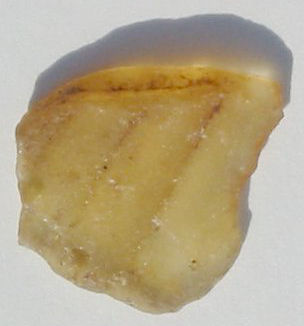
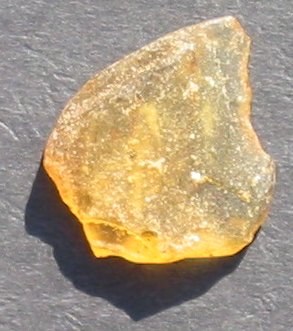
The two pictures here show the same piece of raw amber under slightly different lighting conditions.
Photos by DKJ