Measures of Association
What they are:
They are measures of how closely the values of two variables go together. They measure the extent to which there is a pattern in your data. Also remember, that association (relationship) is one condition of causation.
CRAMER'S V
What it does:
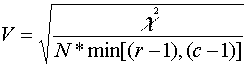
It compares the observed table with the one expected under no relationship,
that is it obtains
Chi-square (the Greek letter Chi, pronounced as KHY and rhymes with sky,
looks like an X italicized, with its left-top-to-right-bottom line
drawn curly)
and then it standardizes this comparison eliminating the effect of sample size (N) and the size and shape of the table.
Where
N= total number of cases in the table
Min[(r-1),(c-1)]= number or rows -1 or number of columns-1, whichever is smaller
and
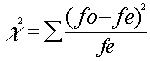
where fo is the observed cell frequency and fe is the frequency expected in the same cell if the two variables were perfectly unrelated (statistically independent).
(Called chi-squared.)
Cramer's V is always between 0 and 1 where 0 means that the two variables are perfectly unrelated and 1 means that they are perfectly related.
GAMMA (g )
What it does:
It compares the positive elements (concordant pairs) and the negative elements (discordant pairs) in the relationship.
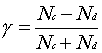
Where
Nc = Number of concordant pairs: pairs where one of the pair is consistently either higher or lower on both variables
Nd = Number of discordant pairs: pairs where one of the pair is higher on one variable and lower on the other.
Concordant Pairs:
|
Y--X |
h |
m |
l |
|
h |
O |
|
|
|
m |
|
# |
# |
|
l |
|
# |
# |
|
Y--X |
h |
m |
l |
|
h |
|
O |
|
|
m |
|
|
# |
|
l |
|
|
# |
|
Y--X |
h |
m |
l |
|
h |
|
|
|
|
m |
O |
|
|
|
l |
|
# |
# |
|
Y--X |
h |
m |
l |
|
h |
|
|
|
|
m |
|
O |
|
|
l |
|
|
# |
Discordant Pairs:
|
Y--X |
h |
m |
l |
|
h |
|
|
O |
|
m |
# |
# |
|
|
l |
# |
# |
|
|
Y--X |
h |
m |
l |
|
h |
|
O |
|
|
m |
# |
|
|
|
l |
# |
|
|
|
Y--X |
h |
m |
l |
|
h |
|
|
|
|
m |
|
|
O |
|
l |
# |
# |
|
|
Y--X |
h |
m |
l |
|
h |
|
|
|
|
m |
|
O |
|
|
l |
# |
|
|
Take O and multiply it by the sum of #, do it for all Os and add them up.

g is always between -1 and +1, where -1 means a perfect negative, +1 a perfect positive relationship and 0 means the perfect absence of a relationship.
Measures of association and levels of measurement:
|
Dependent Variable/ Independent Variable |
Nominal
|
Ordinal |
Interval/Ratio |
|
Nominal |
Cramer's V, Lamba |
Cramer's V, Lambda |
Analysis of Variance (ANOVA) |
|
Dichotomy |
Cramer's V, Lambda |
Gamma |
Difference of means, Pearson's r |
|
Ordinal |
Cramer's V, Lambda |
Gamma |
Gamma, Pearson's r*, Regression* |
|
Interval/Ratio |
|
Gamma, Pearson's r*, Regression* |
Pearson's r, Regression |
*Pearson's r and Regression can be used if the ordinal variable has at least 5 categories and there is no reason to believe that the categories are unevenly paced.